


All of the content available at Public Theology is for those who identify as Christian, as well as those who might be interested in learning about a more inclusive, kind, thoughtful Christianity. To receive new posts and support the work, consider becoming a free or paid subscriber.
Last year was the 1700th anniversary of the Council of Nicaea, the first major ecumenical council of the Christian church held in modern-day Turkey in the year 325 AD. Its primary purpose was to settle a dispute that had arisen among Christians about the nature of the Trinity, but what famously came out of this council is what we now call the Nicene Creed.
Some of you have never heard of the Nicene Creed and others of you come from traditions where you recited it every Sunday. You may even unknowingly know parts of it as Rich Mullins’ song “Creed,” which has been covered by Third Day and Shane and Shane. It starts out like this:
We believe in one God,
the Father, the Almighty,
maker of heaven and earth,
of all that is, seen and unseen.
We believe in one Lord, Jesus Christ,
the only Son of God,
eternally begotten of the Father,
God from God, Light from Light,
true God from true God,
begotten, not made,
of one Being with the Father.
Through him all things were made.
For us and for our salvation
he came down from heaven…
It goes on to talk about Jesus’ incarnation, death, and resurrection, the Holy Spirit and the church. For seventeen centuries, Christians around the world have gathered together and recited this creed. Think about how many Empires have risen and fallen in those 1700 years:
The Roman Empire
The Byzantine Empire
The Ottoman Empire
The British Empire
Countless kingdoms, nations, and regimes that once seemed untouchable have all come crashing down. Think about how many Kings and Presidents, dictators and wannabe dictators have come and gone. Tyrants who thought they were untouchable and leaders who thought their power would last forever have all been reduced to footnotes in our history books.
And yet, our faith remains. Empires crumble and thrones collapse, but the Kingdom of God still endures. Rulers rise and fall, but Jesus outlasts them all. History has a way of reminding us that no empire is eternal and no leader rules forever. Especially in chaotic times like these, we need to be reminded of that truth.
Sometimes it helps to take the long view, because when we zoom out from our current moment, we see that God has always been at work through those who pursue love, justice, and mutual flourishing in the world, and that important work has overcome every empire.
The biblical authors are also quick to remind us that God is often at work in the places we least expect: not in halls of power, but in little towns like Bethlehem; not through conquering kings, but through shepherds and carpenters and young moms; not through those at the center of society, but through those pushed toward the margins.
In fact, when God chose to put on flesh and move into the world he created in the person of Jesus, he didn’t arrive in a palace with pomp and fanfare. He was born to a poor family under imperial occupation. He grew up in a provincial town people had written off. And throughout his ministry, Jesus consistently moved toward those society had overlooked, excluded, or abandoned.
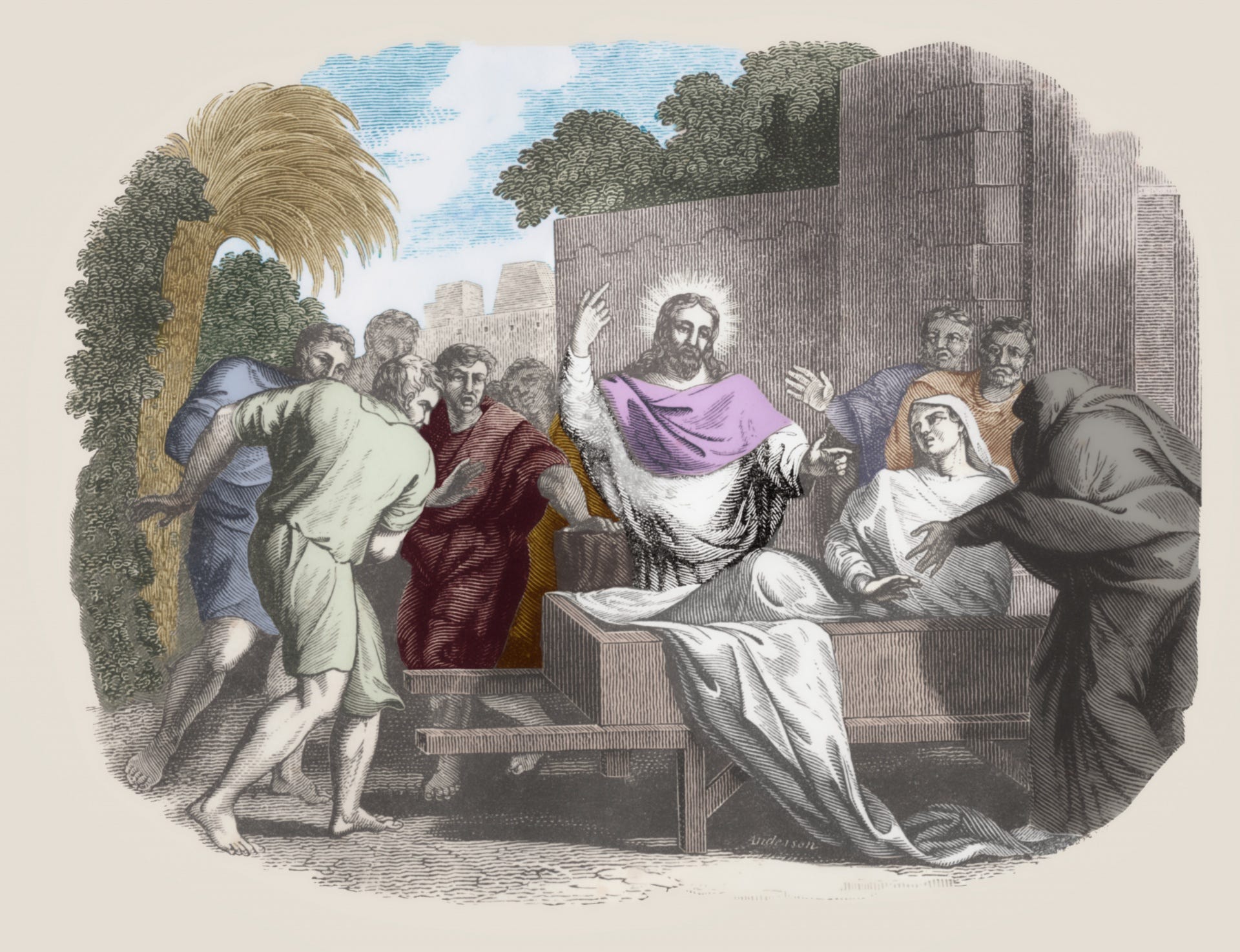
We see this in the story of Jesus raising a widow’s son.
Jesus went to a town called Nain, and his disciples and a large crowd went along with him. As he approached the town gate, a dead person was being carried out—the only son of his mother, and she was a widow. And a large crowd from the town was with her. When the Lord saw her, he was moved with compassion toward her and he said, “Don’t cry.”
Luke 7:11-13
Throughout Scripture, we often see Jesus “moved with compassion” when someone needs help, but this story is a little bit different. Most of the examples provided in the Bible show people coming to Jesus with a request. In fact, right before he meets this widow, a Roman centurion approaches Jesus and pleads with him to help his sick servant who was on death’s door.
But in this story, Jesus is walking toward the gates of a town called Nain when he stumbles upon a funeral procession. The only son of a widow has just passed away, but his mother doesn’t make a request of Jesus. In fact, the biblical authors don’t record her saying anything at all. And how could she? This widow has already lost her husband and is now overcome with grief at her only son’s funeral. I picture her weeping so hard she can’t speak.
And yet, even without a direct request, Jesus comes to her aid. His response is so beautiful.
When the Lord saw her, he was moved with compassion toward her and he said, “Don’t cry.” Then he went up and touched the coffin they were carrying him on, and the bearers stood still. He said, “Young man, I say to you, get up!” The dead man sat up and began to talk, and Jesus gave him back to his mother.
Luke 7:13-15
Jesus’ response here is not only beautiful, it’s instructive. Jesus does three things that give us a model for how we should respond when we happen upon someone who needs help:
See
Move
Help
Let’s give some imagination to what it might look like to put these three actions into practice in our everyday lives.
1. See
This is the first step. If we don’t get this right, nothing else matters. We can’t move toward needs and help meet them if we don’t have eyes to see. And remember, this isn’t just about seeing a problem, this is about seeing a person.
Luke 7:13 says, “the Lord saw her.” It doesn’t say, “the Lord identified the issue” or “the Lord pinpointed the problem.” It says that Jesus saw her: a person in need, not a problem to be solved. This is the consistent practice from Jesus— he doesn’t see people like problems to be fixed or projects to be managed. He treats people with dignity and respect as image-bearers of God.
Far too many of us are walking around with metaphorical blinders on, either unable or unwilling to see the people around us. We focus on issues to debate or content to consume and end up missing the human beings right in front of us. And when this happens, even our attempts to help can be hollow or even harmful. We cannot skip this first step.
Notice that Jesus doesn’t immediately jump into action when he comes face to face with this funeral procession. He sees the widow, he’s overcome with compassion for her, and he offers words of comfort. Jesus doesn’t blow by her emotional state so he can fix what’s broken. He starts with comfort and care. Sometimes we are so ready to solve a problem that we don’t truly see the person in front of us. Our first step should always be to slow down and actually see the human being who needs our help.
2. Move
We must first see the person in need but we can’t stop there, otherwise we risk becoming passive observers— people who notice pain but never move toward it. This risk is especially pronounced in our social media centric culture. We are constantly exposed to people’s pain and suffering and scroll by without much thought. We’re exposed to so much.
When we are conditioned to scroll by people’s pain online, it makes it that much easier to walk by people’s pain in real life. We might have a momentary flicker of compassion, but it comes and goes without us actually moving toward the person in need.
Luke writes that Jesus wasn’t just compassionate toward this widow. Jesus was “moved by compassion” toward her. Did you know that Jesus stops to help someone in need more than fifty times throughout Scripture? Allowing his compassion to move him toward folks in need is one of Jesus’ core characteristics.
“God’s ways are higher than our ways not because he is less compassionate than we are, but because he is more compassionate than we can ever imagine.”
Rachel Held Evans
Jesus shows us that it’s not enough just to see people, we must move toward them. We must allow ourselves and our busy schedules to be interrupted when somebody needs help.
Jesus doesn’t just see this widow from a distance, he closes the gap. He steps into her grief. He moves toward her. This is the invitation for us, too. Not just to be aware, not just to feel something, but to actually move toward people in their pain. This is the pattern we see all throughout Scripture:
The Good Samaritan bends down to help the wounded man.
The father runs toward the prodigal son even when he’s a long way off.
Philip walks right up to the Ethiopian eunuch’s chariot.
Jesus reaches out and embraces the poor, the sick, and the marginalized.
Over and over again, Jesus and his followers don’t stay at a distance— they move toward people who need support. But seeing and moving aren’t enough by themselves.
3. Help
This final step is the least prescriptive because every situation is different and the ways we can help are numerous, but Jesus’ actions in this story help give us imagination for what tangible help can look like. Jesus offers help to the widow in three ways:
He comforts her in her grief
He resurrects the young man from the dead
He centers the marginalized woman
I know what you may be thinking when it comes to Jesus raising the young man from the dead:“I can’t do that.” But the principle here is that we must do whatever we can to meet someone’s immediate need.
If someone is hungry, we give them food. If someone is hurt, we take them to a doctor. If someone is lonely, we sit with them. And so on.
Again, this plays itself out a in a bunch of different ways based on the circumstances, but the takeaway for us should be that we do our best to meet the immediate need just like Jesus did. And Jesus didn’t stop with the obvious need! He sees another way he can help.
The most often overlooked part of this story is how Jesus centers the marginalized woman. In that society, women—especially widows—were oppressed, overlooked, and often left without protection or status. In fact, Luke goes out of his way to describe just how dire her situation is.
Since women in this patriarchal world were fully reliant on the men in their lives, the loss of both her husband and only son means this woman has been left without any means of support. This widow is in one of the most marginalized positions possible.
Which is why it’s so important that Jesus doesn’t just raise her son from the dead, he openly honors her, too. Jesus’ choice to approach her so publicly— in front of both the crowd following him and the crowd at the funeral— means that no one could miss what he was doing.
Jesus is lifting her out of invisibility and placing her at the very center of the story for all to see. In a moment when the crowd could have focused on the miracle, Jesus makes sure they see her, too. Yes, Jesus gives her son back, but he also gives her a place of honor within her community.
“She who is husbandless and sonless and in mourning, she who epitomizes the ‘poor’ to whom Jesus has come to bring good news, is the real recipient of Jesus’ compassionate ministry. In fact, it is not too much to say that “healing” in this instance, although it entails the miraculous raising of this young man from the dead, should be interpreted as the restoration of this woman within her community.”
Joel Green
This is our calling too: not just to meet immediate needs, but to look for the deeper ways we can affirm someone’s dignity as an image-bearer of God. We must use whatever power or privilege we have to make sure people on the margins are seen, valued, and included.
This story isn’t just about a miracle in a small town called Nain, it’s about the heart of God being revealed in the person of Jesus: a God who sees us when we’re struggling, moves toward us in compassion, and helps meet our needs. And above all, we see a God who is with us.
1700 years ago, Christians gathered to declare what they believed about this God. Since then, empires have risen and fallen. Kings, presidents, dictators and tyrants have come and gone. Nations that once seemed untouchable have faded into history. But this truth remains:
God is with us, for us, and faithful to us. And through Christ, God has come to help his people.
This has always been the case. And now, through the Holy Spirit, God is at work in and through us, too. When we see people, when we move toward people, and when we help people, we are participating in the work of God in the world. We are being the hands and feet of Jesus. We are the living expression of “God has come to help his people.”
So it’s not just about what Jesus did back then, it’s about what Jesus is still doing right now through ordinary people like us. Empires will keep rising and falling, leaders will come and go, and the ground will keep shifting beneath our feet, but this is what endures: God is with us and God has come to help us. So when you are feeling overwhelmed by the violence and corruption that pervades so much of the world around us, I want you to remember two things:
God’s love outlasts them all.
And every time we truly see someone, move toward them in compassion, and help meet their needs, we are the embodiment of God’s love for the whole world to see.
If you enjoyed this post, you might enjoy Zach’s book, Better Ways to Read the Bible. To celebrate the book’s first birthday, Zach is hosting a virtual book club during the month of July! Mark your calendars: 7/16, 7/23, & 7/30 from 7:00-8:30pm Central Time. Please complete this form for more information.

Lastly, we are happy to cover subscription costs for anyone who needs it but can’t afford it at this time. If you would like to join the Public Theology community and gain access to our paid subscriber content (which we keep behind a paywall for the privacy and connection of our community) but cannot afford to do so, please message Amy Lambert directly.
A much needed reminder of what's most important.
Thank you, Zach
So encouraging for this moment!